
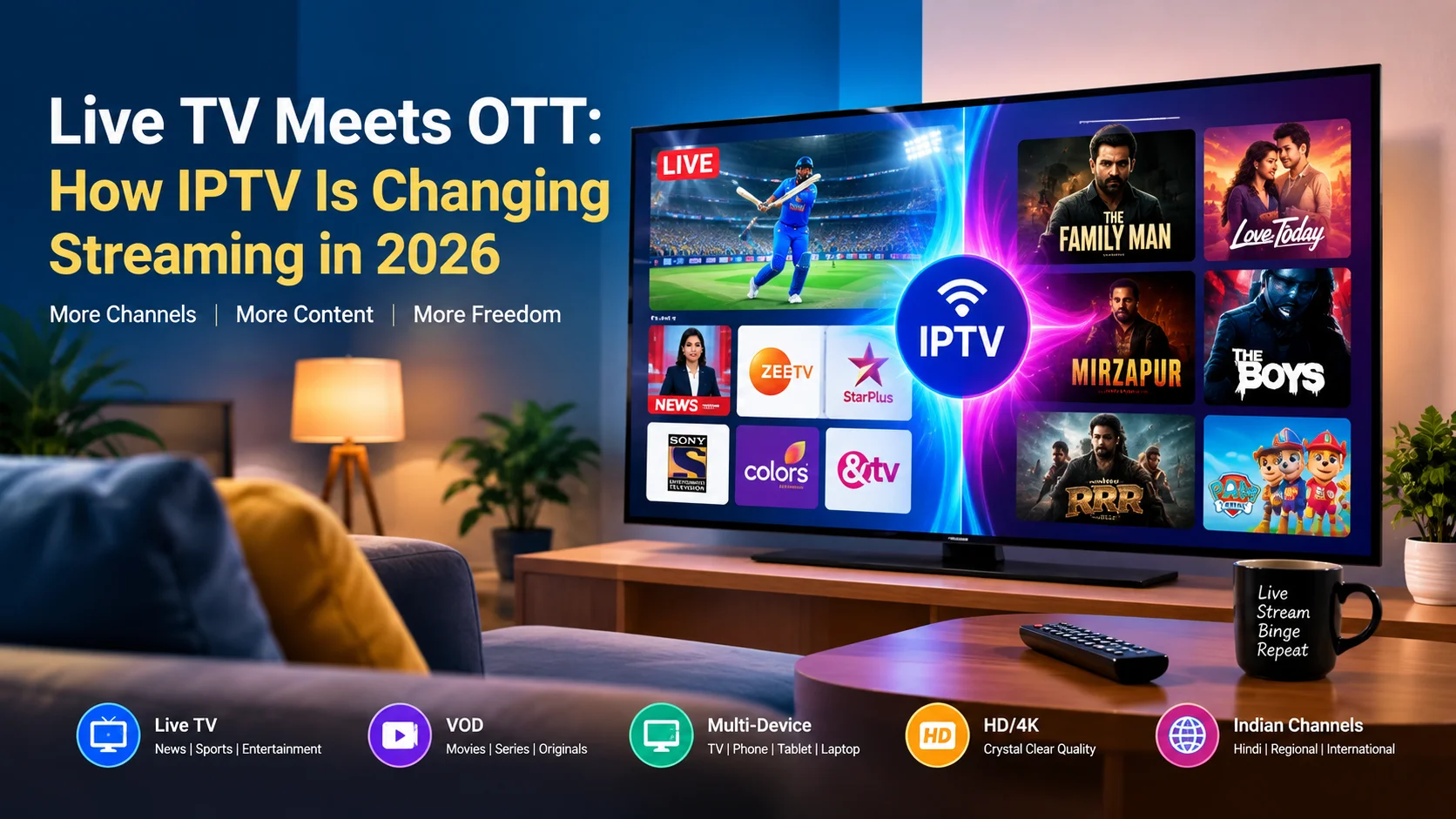

The way people watch television is changing faster than ever. Traditional cable television is no longer the only way to watch live channels, while streaming platforms have moved beyond movies and on-demand series. In 2026, live TV and OTT are increasingly coming together, creating a more flexible viewing experience through internet-connected televisions and streaming devices.
This shift is particularly important for Indian viewers. India's Connected TV audience reached an estimated 206.9 million in 2026, representing 60% growth compared with 2025, according to the Ormax OTT Audience Report 2026. The same report estimates India's overall OTT audience at 664.9 million.
As viewers become more comfortable watching content online, Indian IPTV is becoming part of this broader transformation.
What Is Changing in Television Streaming?
For many years, television was divided into two main categories.
Cable and satellite services provided scheduled live television, while OTT platforms focused primarily on on-demand movies and series.
That distinction is becoming less clear.
Modern streaming users increasingly expect to find different types of entertainment in one connected environment:
- Live TV
- Movies
- Series
- Sports
- News
- Regional programming
- Video on demand
- Catch-up content
IPTV technology fits naturally into this changing environment because television programming can be delivered through an internet connection rather than relying exclusively on traditional broadcast infrastructure.
Why Is IPTV Becoming More Relevant in 2026?
One reason is convenience.
Viewers already use the internet for entertainment, communication, shopping and work. Watching television through an internet-connected device is therefore a natural extension of existing digital habits.
The growth of connected TV is another major factor. Industry research indicates that India's CTV audience has grown rapidly, with viewers increasingly using large screens for online video consumption.
For an IPTV service in India, this creates an opportunity to bring live television and digital streaming closer together.
IPTV vs OTT: What's the Difference?
Although IPTV and OTT both use the internet, they are not exactly the same thing.
IPTV, or Internet Protocol Television, generally refers to television content delivered through IP-based networks, often with an emphasis on live channels and scheduled programming.
OTT, or Over-the-Top content, generally refers to video delivered over the public internet independently of traditional cable or satellite television infrastructure.
In practical terms, the two experiences are increasingly overlapping.
A viewer may watch live Indian television through an IPTV service and then switch to an OTT platform for an on-demand movie or series.
The important development is that consumers increasingly want choice and flexibility, rather than being restricted to one traditional viewing method.
The Rise of Indian Live TV Online
One of the biggest advantages of internet-based television is access to programming from different regions.
Indian television is highly multilingual. Viewers may want Hindi entertainment one day, Punjabi programming the next, and Tamil, Telugu, Malayalam, Bengali or Gujarati content at another time.
This is why searches for Indian TV channels online and Indian live TV remain relevant.
An IPTV platform can potentially bring different language categories into one viewing environment, depending on the provider's available programming and distribution rights.
For families living outside India, online access can also make it easier to stay connected with familiar regional entertainment and news.
Smart TVs Are Driving the IPTV Experience
Smart TVs have played a major role in the growth of connected television.
Instead of requiring a separate television connection, many modern TVs can connect directly to the internet and run supported applications.
This has changed what people expect from their television.
A Smart TV can now function as a central entertainment hub for:
- Live television
- OTT applications
- Movies
- Music
- YouTube
- Sports
- News
- IPTV applications
For IPTV users, this means compatibility and simple setup are becoming increasingly important when choosing an Indian IPTV service.
Streaming Devices Are Also Important
Not every television offers the same operating system or application support.
Streaming devices can provide another way to access online entertainment.
Depending on the service and supported applications, viewers may use devices such as:
- Fire TV devices
- Android TV devices
- Streaming boxes
- IPTV boxes
- Smartphones
- Tablets
- Computers
Before subscribing to any IPTV service, users should check whether their specific device and operating system are supported.
What Do Viewers Expect From Modern IPTV?
The definition of a good television service is changing.
Channel quantity is still important, but viewers are increasingly considering the entire experience.
Live Channels
Users want access to live programming without complicated navigation.
Electronic Program Guide
An EPG can help viewers discover current and upcoming programs more easily.
Video on Demand
VOD allows viewers to watch available movies and shows according to their own schedule.
HD and 4K
Higher-resolution content can provide a better experience on compatible displays when the source, device and internet connection support it.
Multi-Device Access
Many households use several connected devices, making compatibility an important consideration.
Reliable Support
Clear setup instructions and customer assistance can be useful when technical or account-related issues occur.
Regional Content Is a Major Opportunity
India's television audience is not limited to one language.
Hindi remains an important part of Indian entertainment, but viewers also actively consume programming in Punjabi, Tamil, Telugu, Malayalam, Bengali, Marathi, Gujarati, Kannada and other languages.
This creates an important opportunity for IPTV services.
Instead of requiring viewers to find separate sources for different regional programming, a well-organized service can make multiple language categories easier to discover.
For Indian families living in the USA, Canada and other international markets, access to regional programming can be particularly valuable.
IPTV and the Future of Television
The future of television is unlikely to be defined by one technology alone.
Instead, viewers are likely to continue combining different forms of entertainment.
A typical evening could involve watching a live news channel, switching to a sports broadcast, opening an on-demand movie and later returning to live television.
This is where IPTV and OTT begin to complement each other.
The viewer is less concerned about the technology behind the content and more interested in whether the content is easy to find, works on their device and provides a reliable viewing experience.
How to Choose an IPTV Service in 2026
If you're searching for the best Indian IPTV, avoid choosing a provider based only on a large advertised channel number.
Instead, consider these factors.
1. Check the Current Channel Lineup
Make sure the channels you actually watch are available.
Look for the Indian languages and categories that matter to your household.
2. Check Device Compatibility
Confirm that the service supports your Smart TV, Fire TV device, Android device, Apple device, IPTV box or computer.
3. Review Streaming Quality
Check whether HD or 4K content is available where you need it and whether your internet connection is suitable for the desired resolution.
4. Look at the EPG
A useful electronic program guide can make live television much easier to navigate.
5. Check VOD Availability
If you want more than live television, review the available on-demand content.
6. Understand Subscription Terms
Before purchasing, review:
- Price
- Subscription duration
- Renewal terms
- Cancellation policy
- Refund conditions
- Supported devices
7. Verify Content Rights
IPTV is a technology for delivering video over the internet. The legality of particular programming depends on whether the provider has the necessary rights or authorization to distribute that content in the relevant market.
What Does This Mean for Indian IPTV?
The growth of connected television creates a strong environment for internet-based television services.
An IPTV service India audience is no longer necessarily looking only for a replacement for cable television. Users increasingly want a flexible entertainment experience that works across connected screens and fits around their viewing habits.
For providers serving Indian audiences, this means the focus needs to extend beyond channel quantity.
The overall experience matters:
Content + Compatibility + Quality + Convenience
These factors can influence whether viewers continue using a service over time.
The Next Stage of Live TV Streaming
The combination of live television and OTT represents a broader change in how people think about entertainment.
Instead of asking whether they should choose cable, IPTV or OTT, viewers may increasingly use multiple services depending on what they want to watch.
Connected TV makes this possible by bringing different forms of digital entertainment onto the same large screen.
For Indian viewers, this can mean easier access to live television, regional programming, movies, sports and other online content.
Final Thoughts
The relationship between live TV and OTT is changing in 2026. Connected television is growing rapidly, internet-based viewing is becoming mainstream, and viewers increasingly expect flexibility across devices and content types.
For people exploring Indian IPTV, the most important consideration is not simply the number of channels advertised. A better approach is to compare the available programming, supported devices, streaming quality, EPG, VOD features, subscription terms, customer support and applicable content rights.
As live television and OTT continue to converge, IPTV is becoming part of a larger shift toward flexible, internet-connected television.
For viewers interested in Indian TV channels online and Indian live TV, this evolution means more ways to access television on the screens they already use.